The Watch That Ticked Backwards
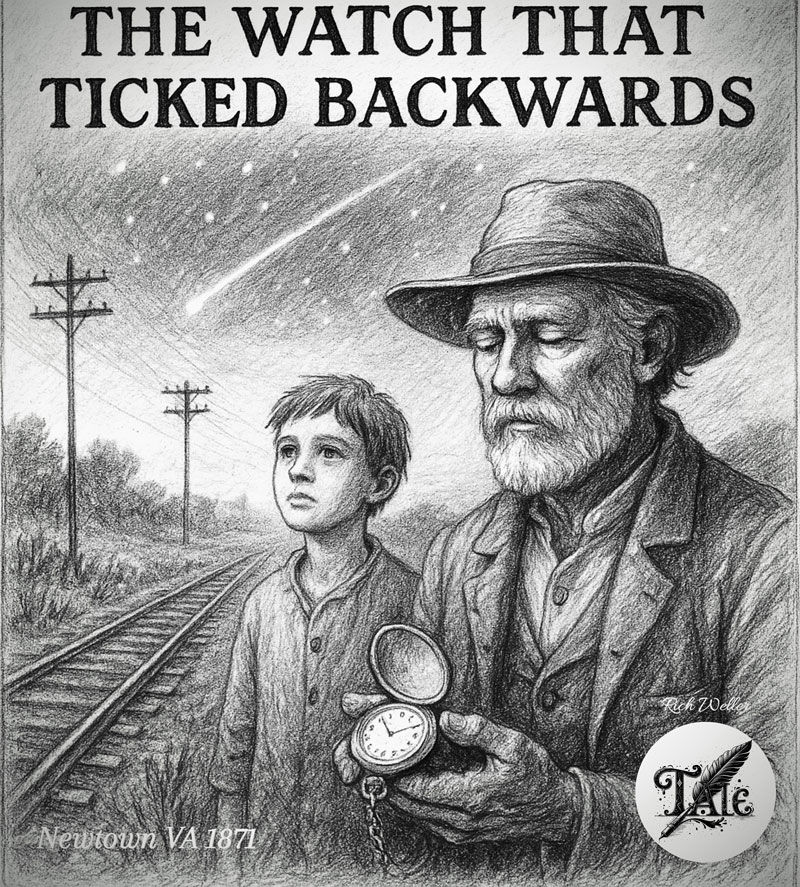
Newtown, Virginia — In the Summer of 1871
By Rich Weller
The summer sat heavy upon Newtown, Virginia. The sun bore down without mercy, and the roads lay bleached and cracked beneath its gaze. Not even the wind stirred, as though the very air had grown weary. Along the edge of Main Street, where the town gave way to fields and dust, stood a crooked little shop with leaded glass and oil-stained wood. It was there that Amos Whitlow passed his days, alone with his clocks.
Amos was a quiet man. A watchmaker by trade, he had the look of one who had long made peace with silence. Since the passing of his wife, may the Lord keep her, he had kept to his hours and his tools, mending time as best a man could. The tick of gears and the smell of brass filled his shop, and that was company enough.
One hot afternoon, when the air hung thick and no sound stirred in the street, the bell above his door gave a thin chime.
A boy stood there.
He was no more than ten, barefoot, dusty, and still. His shirt hung loose on his frame, and his face held a kind of quiet knowing. He said nothing. In his hands he held out a broken pocket watch, the glass cracked and the chain dark with rust.
Amos studied it for a moment, then gave a small nod and took it to his bench.
By lamplight he opened the casing, cleaned the gears, and fitted the spring with steady hands. When the final pin was set and the case closed, the watch sprang to life.
But its hands moved backward.
Not hesitantly, but smooth and certain, as though time itself had turned in on itself.
The boy took the watch without surprise. He looked up at Amos and gave the faintest nod. Then he turned and walked out into the heat of the day.
That night, Amos dreamed.
He dreamed not as an old man dreams, but as a younger man remembers. He saw his Martha standing under the cottonwood tree. She was laughing, just as she had on the day they carved their initials into its bark. Her eyes were bright. Her hands were warm. She was not gone. She was there.
When he awoke, the tears on his pillow were real.
The boy returned the next day. He said nothing. He simply pointed to the strange watch, then lifted his hand toward the sky. The same thing happened the next day, and the one after that.
On the fourth evening, Amos followed him.
They passed the last lantern at the edge of town and walked out into the fields, where the tall grass whispered and the shadows deepened. The boy said nothing, but he did not hurry. Amos kept pace behind him.
They came at last to the railroad tracks.
This stretch of track had not seen a train in years. Most folks in Newtown avoided it after dark. Stories had clung to it like vines. Talk of strange lights. Sounds that had no source. Whispers that seemed to come from the stones. The sort of stories folks tell low and do not care to prove.
But that night, everything was quiet. Too quiet.
Amos felt it in the air, thick and watchful. The boy stepped near the rails, and the pocket watch he carried began to glow. Faint at first, then steady, like firelight trapped behind silver glass.
The rails shimmered with that light, as if they too remembered something long buried.
And then the sky opened.
One streak of light tore across the darkness, then another and another, until the heavens spilled stars in silence. It was a shower of fire, slow and wide, and not one soul spoke. Others had come too. Folks from town gathered near without knowing why. They stood among the grass, faces lifted, held in wonder.
When the dawn crept in on quiet feet, Amos turned to speak to the boy.
But the boy was gone.
No footprints in the dew. No shadow. No sound.
Amos looked down and felt a weight in his coat he had not noticed before. He reached into the pocket and pulled out the very watch he had once mended. The same one the boy had taken with him.
He had no memory of the boy giving it back.
He opened it.
The hands now moved forward. Calm. Sure. Just as any watch should. But Amos knew it was not ordinary. There was something in it still. A warmth. A memory that refused to fade.
He never saw the boy again.
But he kept that watch. Through all his days, he carried it. Its ticking reminded him of things he could not explain but knew were true. That there are moments time does not hold. That some memories are gifts. That silence does not mean absence.
And in the quiet hours of old age, Amos would sit by his lamp, the watch in his hand, and believe with all his heart that some things lost might yet be found again.
Lore: A Series of Stories
© Rich Weller Elevate Media LLC All Rights Reserved